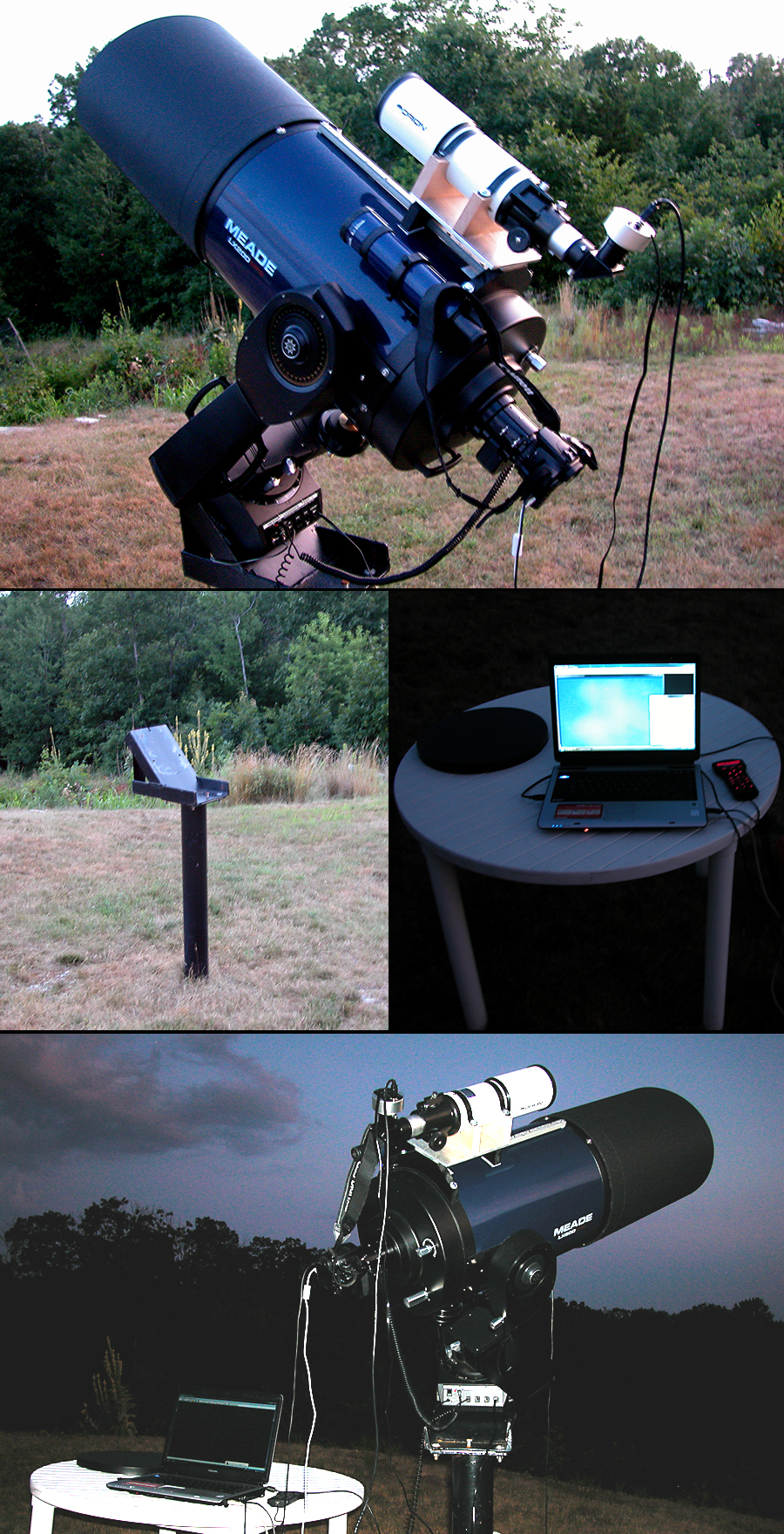
12-inch Meade f/10 LX200
The basic components of my present
set-up for telescopic imaging include:
In this picture, the camera is
connected directly to the telescope so it is working at f/10, but in some cases
I insert a focal reducer, which yields f/2.8 in this configuration. The camera is controlled by a laptop
computer using ImagesPlus software. The software allows me to control many
of the camera settings from the computer, including exposure duration, ISO,
number of exposures, and image format (I use Canon raw image format). As an example, once I try some test
images to get my target centered and in focus, I can program the software to
take 20 consecutive exposures, each 120 seconds in duration. There is a delay of about 20 seconds between
exposures as the raw image is downloaded to the laptop and displayed on the
screen. While the exposures are
being taken, I can do visual observing with another telescope or go inside to
warm up.
The autoguider, connected to the guidescope,
does a good job of tracking during a long series of exposures, and it is easy
to use. I simply click on any star
that appears in the view on the computer screen, and the autoguider
keeps that star on target. Flexure
between the main telescope and the guidescope are a
potential source of concern, but with a series of relatively short exposures
(each 3 minutes or less), I have not found it to be a problem.
The only part of the set-up that
always remains outside is the pier and the simple equatorial wedge that I built
out of a few pieces of channel iron and had welded. The wedge has adjustment bolts so that
it can be accurately polar-aligned.
I did this alignment using the star-drift method over two years ago, and
I have not had to touch it since then.
Carrying out the telescope and all
the accessories for each observing session takes about 10 minutes. So far I have not found this to be too
burdensome, but maybe some day I will build a small observatory structure
around the pier so that the telescope can remain permanently mounted.