| NGC 6302 is a good example of a bipolar planetary nebula--one with two lobes or projections pointing in opposite directions. It is also called the Butterfly Nebula because in some photos the two lobes resemble a butterfly's wings. At magnitude 9.5, it is not too difficult to observe in a medium-sized amateur telescope. It is estimated to be about 3,400 light years away. |
 |
| Evening visibility: |
July-September |
| Best viewed with: |
binoculars, telescope |
| |
Printable chart (pdf) |
View larger image |
Directions:
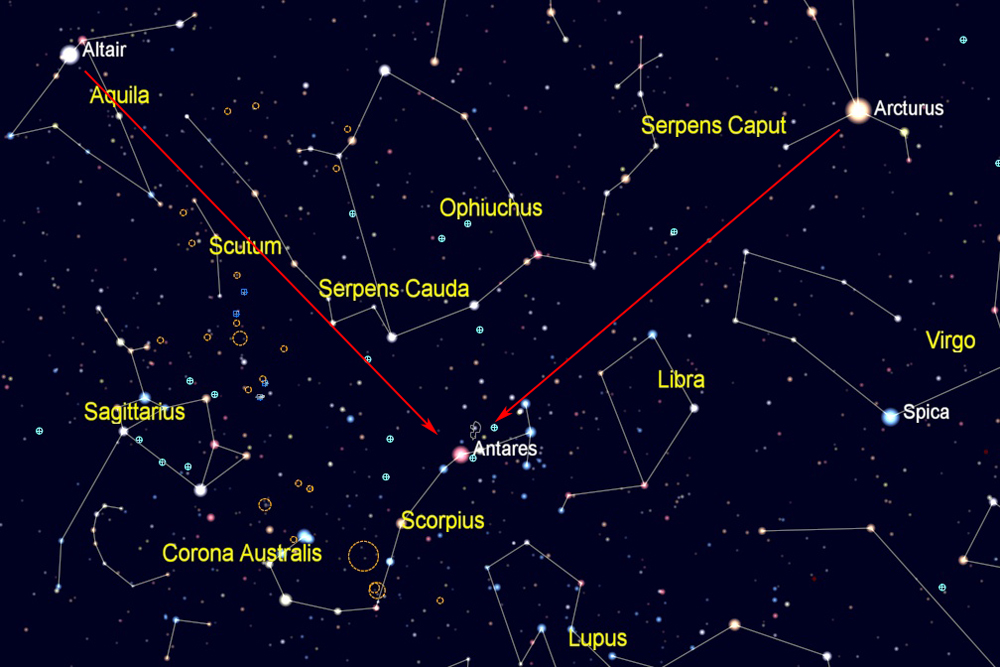
Start by finding first magnitude Antares, the brightest and reddest star low in the southern sky on summer evenings. To get oriented, note that Antares is about 60 degrees southwest of Altair (part of the Summer Triangle) and a similar distance southeast of Arcturus (part of the Spring Triangle). Antares represents the eye of Scorpius, and on a clear night you should be able to see the curving shape of the scorpion if you have a good view of the southern horizon.
|
.. |
| From Antares, look about 20 degrees to the east-southeast for a bright pair of stars (including Shaula, magnitude 1.6) that form the tip of the scorpion's tail. This distictive pair is easy to see as long as you have a good view of the southern sky. From Shaula, the Bug Nebula is 4 degrees to the west. To help you get oriented, note that the Bug Nebula is also about 5.5 degrees to the east-southeast of Epsilon (ε) Scorpii, which forms part of the curving body of the Scorpion, as shown in the chart below. |
 |
| Star charts created with Cartes du Ciel |
| |
| |