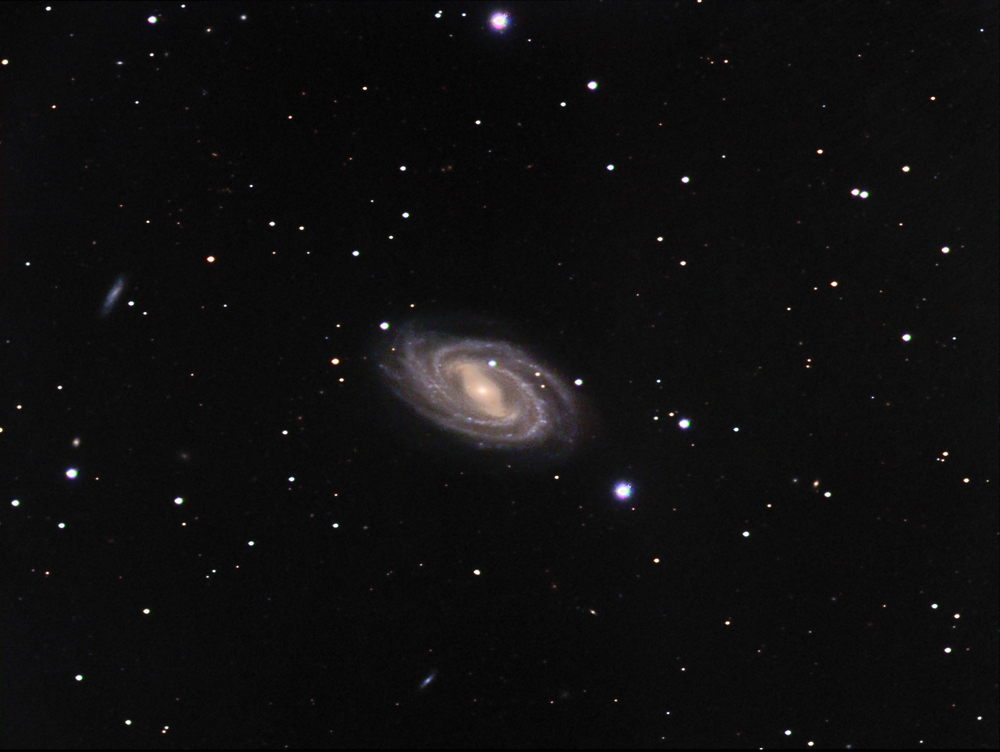
Galaxy in Ursa Major
The second-to-last object in Messier's catalog is a fine example of a barred spiral galaxy--the yellowish nucleus had two long extensions that show up very well in this picture. Its spiral arms begin at the ends of the bars rather than at the nucleus. As in most galaxies, the spiral arms are bluer than the nucleus because they are locations of intense star formation, and many of the newly-formed stars are hot, bright, blue-white, and fast-burning.
Messier 109 is bright enough to be glimpsed through a good pair of binoculars, and it is easy to locate. It is just about 2/3 degree southeast of Phecda, the star that marks the bottom corner of the Big Dipper's bowl that is nearest the handle.
Also visible in this picture are two smaller galaxies that are apparently satellite galaxies of Messier 109--galaxies that are gravitationally bound to Messier 109 and slowly orbit it.
| Magnitude | 9.7 |
| Apparent Size | 8' x 5' |
| Distance (light yrs) | 82 million |
| Right Ascension | 11:57.6 |
| Declination | +53 23 |
| Field of View | 29' x 22' |
Image details: Exposure times of 45 minutes luminance, 21 minutes red, 21 minutes green, and 30 minutes blue, taken with an SBIG ST-8300M imager and a 14" Meade LX850 telescope at f/6.
April 2015