| |
 |
Star Cloud in the Milky Way
Star-hop chart
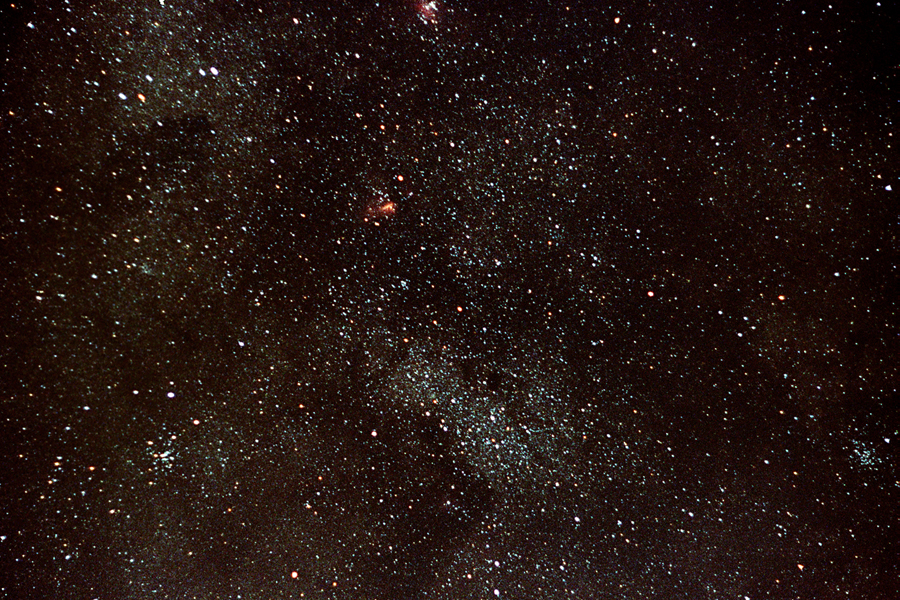
On a summer evening, if you are in a location that is clear enough and dark enough to see at least some parts of the Milky Way, you should be able to see Messier 24 with the unaided eye. It is one of the brightest patches of the Milky Way, an oblong oval about 4 times the diameter of the Moon in length, sitting above the teapot shape of Sagittarius. Through binoculars or a telescope with a low-power eyepiece, this is a wonderful area to scan and take in the view. You are looking at a star cloud--a section of the Milky Way very rich in stars, about 15,000 light years away. The two dark nebulae seen at the northern edge of Messier 24 in this image should also be visible if you look carefully.
The small rich star cluster to the left of center in this image is NGC 6603, which is sometimes mistakenly identified as M24.
| Magnitude |
4.6 |
| Apparent Size |
120' x 60' |
| Distance (light yrs) |
15,000 |
| Right Ascension |
18:18.8 |
| Declination |
-18 33 |
| Field of View |
2.1 x 1.9 deg |
Image details: Mosaic of two panels, both from 15 exposures of 30 seconds, taken with a Dwarf Mini telescope.
August 2026
|